
Authoritarian AI dystopia poses existential threat to democracy if left unchallenged
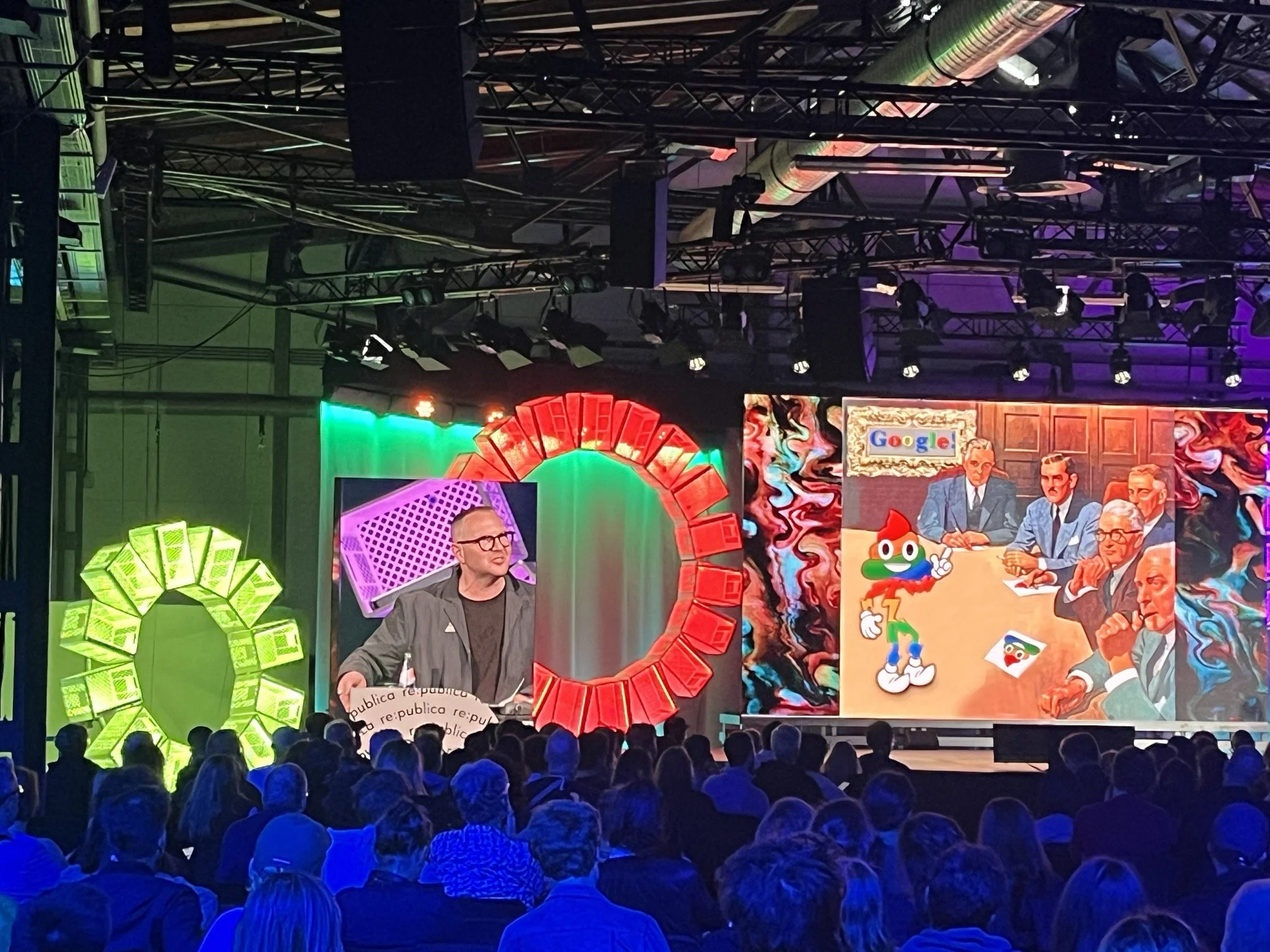
Science fiction novelist, journalist and tech activist Cory Doctorow speaking at re:publica 26 in Berlin. Image: Philipp Wissing
Europe’s leading digital society festival opened this week in Berlin with warnings that the uncritical embrace of generative AI obscures the dangers posed by power concentrated in the hands of a small number of tech oligarchs intent on monetising attention, eroding digital sovereignty and building a dystopian world of automated authoritarian information states.
The keynote address at re:publica 26, attended by Blueprint for Free Speech, was delivered by Karen Hao, award winning journalist and New York Times bestselling author of Empire of AI.
She argued the most compelling promises made about generative AI – better healthcare and education, a faster energy transition, cleaner air and water – are not really promises about generative AI at all. They rest on machine-learning approaches that long predate ChatGPT. The narrative that fuses these older, narrower benefits with the project of building ever-larger frontier models was authored largely by the companies that stand to gain from it. What it obscures is power. Hao described the leading AI firms as empires in the full sense of the word – concentrating extraordinary resources, infrastructure and political reach in very few hands. A return to empire, she reminded the room, is the unravelling of democracy.
Science fiction novelist, journalist and tech activist Cory Doctorow later picked up the thread from a different angle. His topic was the internet landscape we actually inhabit, with digital feeds increasingly composed of AI slop, attention monetised at every turn, and digital sovereignty hollowed out by a small number of platform monopolists. The term he has given to this drift – “enshittification" – is now widely borrowed, but his point is spot on. The degradation of these platforms is not entropy. It is done by design. Platforms have been deliberately engineered to allow firms to extract progressively more value from users and business customers, with content quality and user welfare giving way to whatever the sector requires.
Social theorist and digital ethics academic Anna-Verena Nosthoff supplied the conceptual thread. Drawing on her work in “Kybernetik und Kritik”, she asked why figures such as Elon Musk reach so readily for the vocabulary of cybernetics – X as a “cybernetic superintelligence”, the human as “cyborg”. The choice of words is not incidental. Cybernetic thinking – feedback-driven steering, human-machine symbiosis, the dream of an automated information state – has long shaped how Silicon Valley imagines politics and governance. Nosthoff traced its expression from Musk’s DOGE to Palantir’s Gotham to the AGI hype, and argued that in the hands of today’s tech oligarchs these narratives are taking on a distinct authoritarian shape. She gave it a name: cybernetic authoritarianism.
Read together, they describe one continuous problem at three levels. Nosthoff names the operating ideology – a worldview in which societies are systems to be steered and human beings are nodes in a feedback loop. Hao shows what that ideology produces at the level of industry: empires of computing, capital and political reach. Doctorow shows what it feels like once it touches the surfaces where most people actually live with these systems – their feeds, their workplaces, their public sphere. Ideology, infrastructure, interface.
None of the three speakers were despairing. Each argued, in their own voice, that the trajectory is a product of choices and can therefore be chosen against.
That is the conversation we came to Berlin for.
