
Arming against weaponised deepfakes and engineered consent
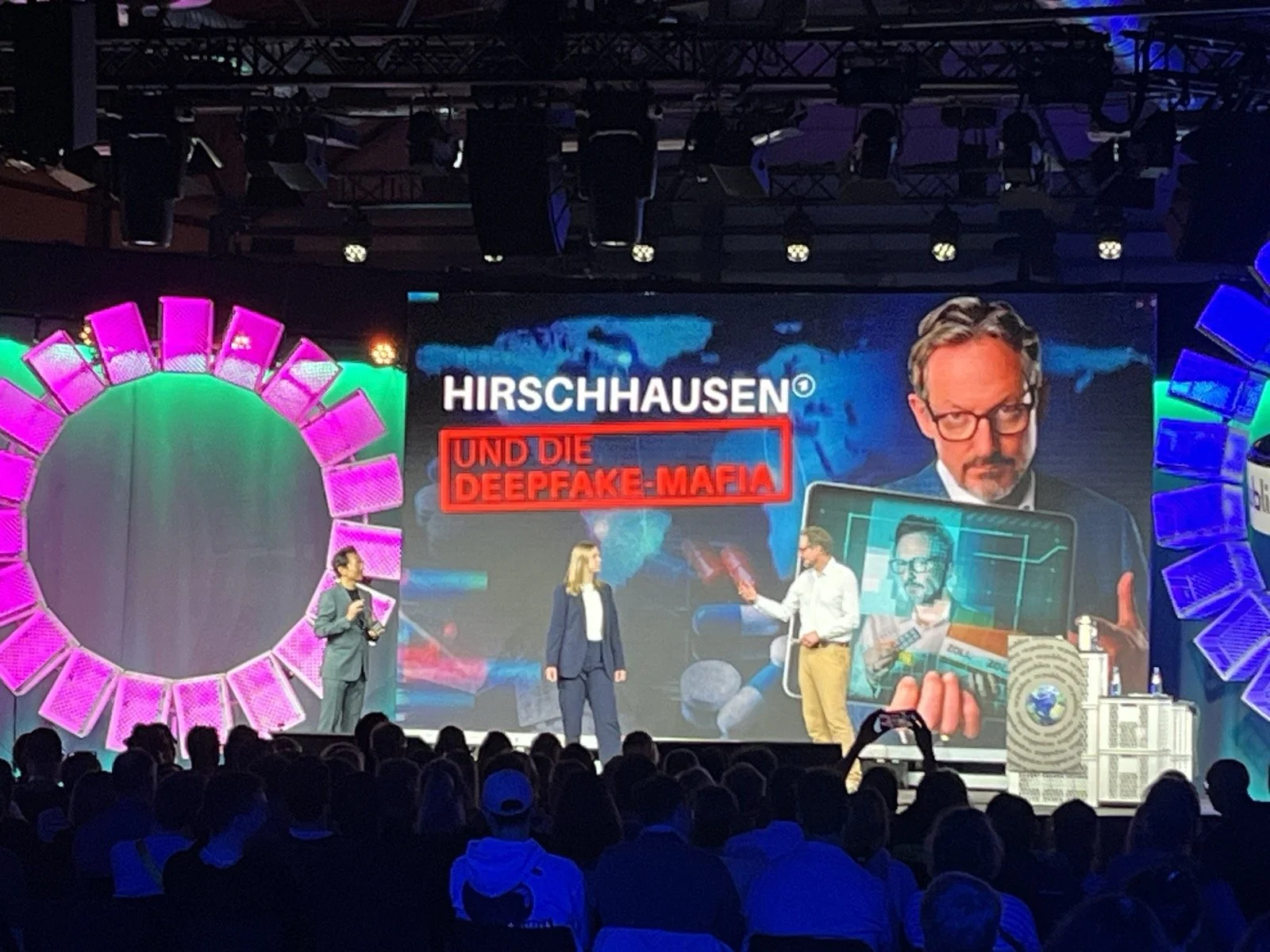
Deepfakes came under the spotlight at re:publica 26 in Berlin. Image: Philipp Wissing
The devastation wrought by deepfakes, and what can do to fight them effectively, took centre stage at the at re:publica 26 in Berlin this week.
Europe’s leading digital society festival opened on Monday by mapping the problem at the level of ideology, infrastructure and interface. For the next two days, speakers turned their attention to a deeper question that matters most to our work at Blueprint for Free Speech: what do we actually do about it?
Lawyers Chan-jo Jun and Jessica Flint tackled the issue of synthetic media production from the legal practitioner’s side – what deepfakes do to real people and brands, and what legal tools can be used to actually push back. This conversation matters a great deal to Blueprint. Jun and Flint both serve on the legal advisory board of noslapp.de, a Blueprint project that confronts abusive lawsuits increasingly used to silence journalists, whistleblowers and civil society. Deepfakes and SLAPPs are two faces of the same threat – manufacturing doubt and suppressing the voices of those who document the dangers.
The thread was picked up by Joschka Selinger – also on the noSLAPP.de advisory board – and Vivian Kube, who dismantled one of the right’s most effective rhetorical weapons in a talk titled “Neutrality won’t protect you”. They pointed out the notion of “neutrality” has been weaponised to delegitimise teachers, public servants and NGOs who simply wish to defend democratic values. They argued passivity dressed up as neutrality does not provide protection – it amounts to surrender.
The day’s conceptual highlight was Canadian historian Quinn Slobodian’s talk, “Godwin’s Engine: Muskism and the automation of consent”.
Earlier this week, social theorist and digital ethics academic Anna-Verena Nosthoff outlined the concept of what she termed “cybernetic authoritarianism” to describe how tech oligarchs such as Elon Musk were intent on eroding digital sovereignty and building a dystopian world of automated undemocratic information states.
In his talk, Slobodian unpacked the propaganda mechanics of this concept. He argued Musk is not merely tolerating extremism. Rather, he is deliberately steering discourse past Godwin’s Law (the longer an online discussion, the more likely a Nazi comparison will be made) to MechaHitler – what X chatbot Grok called itself when praising Hitler. Slobodian calls it “cyborg conservatism”, which floods the zone with content that normalises hierarchy, social exclusion and treating outsiders like viruses to be isolated. Legitimacy is automated through a platform and its chatbot, with approval manufactured and consent engineered rather than earned.
The final day of this year’s digital society festival took the discussion to an increasingly important focus area for Blueprint: ethical AI labour practices. The German Trade Union Confederation (DGB) explored what generative AI – now embedded in everyday workplaces – means for working conditions, and how core democratic values can be baked into its DNA. This is the terrain of payslips, shift schedules and algorithmic performance reviews where trade unions have the most at stake and wield the most leverage.
Later, investigative journalist Carole Cadwalladr shared her insights on surviving techno-authoritarianism, Constanze Kurz and Franziska Görlitz detailed why the spread of Palantir-style policing software is a constitutional problem regardless of who owns the software, and the team at digital rights platform Netzpolitik.org behind the Databroker Files outlined how location-data markets quietly threaten everyone’s right to privacy – including that of workers.
Across three days, re:publica 26 traced an arc from ideology to interface to consequence – and refused to end in despair. A recurring theme heard at the conference, from Hao and Doctorow to Selinger and Slobodian, was that none of the dangers warned against were inevitable. Concentrated power, manufactured consent and the hollowing-out of ethical labour practices are all products of choices. They can be chosen against — in courts, in workplaces and in public life.
For those of us working to connect AI safety with the concrete interests of workers and their unions, that is precisely the conversation we want to continue.
